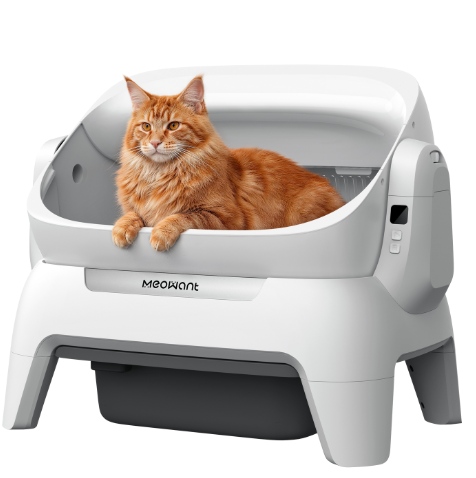

Households with two, three, or more cats face a litter problem that single-cat guides rarely address. The volume of waste multiplies, the smell arrives faster, and the social dynamics between cats can turn a shared box into a source of stress. Owners in this situation often ask whether an automated unit can handle the load, or whether the whole category is designed for one pampered cat in a quiet apartment.
The honest answer is that automatic cat litter boxes can work well in multi-cat homes, but the requirements are stricter. Capacity, cycle behavior, and placement all matter more, and the way cats share territory changes what counts as a good setup. This guide looks at those differences directly.
How Multi-Cat Volume Changes the Math
Every estimate you read about waste capacity assumes a single cat. Double the cats and you roughly double the daily volume, which means a drawer rated for a week of single-cat use may need emptying every three or four days. Triple the cats and the gap widens further. This is not a reason to avoid automation, but it is a reason to choose capacity honestly. A unit with a large sealed compartment will handle a multi-cat home far better than a compact model that looks sleeker on the product page.
Frequency matters as much as volume. In a busy household, the box may be visited a dozen times a day, and each visit triggers a cycle. That means the motor runs more often, the rake works harder, and consumables like liners get used faster. A well-built unit is designed for that duty cycle; a lightweight one may start to show wear within a year. When you compare automatic cat litter boxes for a multi-cat home, weight the build quality and service life more heavily than you would for a single cat.
Territory, Sharing, and Stress
Cats are not naturally inclined to share a bathroom. In the wild, they use separate locations and avoid confrontation around resources. A single automated box in a multi-cat home concentrates that resource, and if one cat guards it or another is timid, the result is accidents outside the box. Behaviorists generally recommend one box per cat plus one extra, and automation does not change that principle. Two automatic units for three cats is a better setup than one large unit, even if the large one has the capacity.
Why Separate Locations Help
Placing both units in the same corner does not solve the sharing problem, because the cats still interact in one area. Spread them across the home — one on each floor, or one at each end of a long hallway — so a cat that is being chased has somewhere else to go. This also reduces wear on any single machine and gives you a backup if one unit needs cleaning or repair.
Entry and Exit Under Pressure
Shared boxes see more traffic at the entrance, and cats often pause at the opening to check for other cats. A unit with a narrow entry or a steep step can become a bottleneck. Look for a wide opening and a stable platform, and watch how your cats queue at the box during busy periods. If one cat blocks the entrance while another waits, adding a second unit in a different room resolves the tension more reliably than any sensor feature.
Choosing a Unit for a Crowded Household
The selection criteria shift in a few specific ways when several cats share a box. First, prioritize sensor reliability over feature count. With multiple cats, the chance of a false trigger rises, and a unit that cycles unexpectedly while a cat is nearby will quickly teach the whole group to avoid it. Second, choose a design with a large, well-sealed drawer and easy-to-source liners, because you will be emptying it far more often than a single-cat owner. Third, consider noise. A quiet motor matters more in a home where the box is used throughout the day and night.
Weight limits also deserve attention. A large adult cat can be significantly heavier than the average, and the sensor calibration needs to recognize that weight without misreading it as an obstruction. Check the supported weight range and read owner reports from households with big cats. A unit that misreads a heavy cat will stall mid-cycle, which is both frustrating and a safety concern.
Maintenance on a Multi-Cat Schedule
The maintenance routine that works for one cat falls apart with three. Empty the drawers on a fixed schedule rather than waiting for a full indicator, and clean the interior more frequently, because residue builds faster when the box is in constant use. Wipe the sensors weekly; dust and litter film are the most common cause of missed detections, and in a busy home the film accumulates quickly. Deep-clean each unit monthly, and stagger the cleanings so you always have one box available while the other is drying.
Consider keeping a manual box as a permanent backup even after automation is running smoothly. In a multi-cat home, a simple open box in a quiet corner costs little, requires a quick scoop, and gives a nervous or senior cat a low-pressure alternative. It also keeps the household running if an automated unit needs cleaning or repair. Owners who treat the automated units as the primary setup and the manual box as insurance tend to report the fewest accidents.
Keep a simple log for the first month after switching to automation. Note which cat uses which box, how often the drawers fill, and any accidents. Multi-cat households often reveal problems that a single-cat owner would never notice, such as one cat avoiding a particular unit. Catching that early is much easier than solving it after a habit has formed. Meowant’s units are straightforward to disassemble for cleaning, which helps when you are maintaining two machines instead of one.
Handling the First Month Together
The first month after installing an automated unit in a multi-cat home is a test of observation as much as equipment. Watch which cats use which box, whether anyone waits at an entrance while another cat occupies it, and whether accidents appear in the usual spots. These patterns tell you more than any app dashboard. If a cat suddenly avoids the box, look for a recent cycle that ran while it was nearby, a change in litter, or a new cat claiming the area.
Keep the transition gentle. Introduce one automated unit at a time rather than replacing every box at once, and leave the simple boxes in place until all cats are using the new setup consistently. Feed the cats in separate areas to reduce competition, and keep water away from the litter area. Small environmental changes often resolve sharing problems that look like equipment failures.
If conflict persists despite extra boxes and separate locations, consult a veterinarian or behaviorist. Resource guarding around litter can signal stress or an underlying medical issue, and automation will not fix either. The machine is a convenience, not a solution to feline social problems.
When Automation Is Not the Right Fit
There are households where the money is better spent on additional manual boxes. If your cats have a history of conflict around resources, if one cat is elderly or has mobility issues, or if the group includes a kitten under six months, a set of large open boxes is safer and simpler. Automation adds convenience, but it cannot resolve social tension, and a machine that cycles unexpectedly can make a tense household worse.
A hybrid setup often works best: one automated unit for the confident cats and one or two simple boxes in quiet locations for the rest. This approach keeps the labor savings while respecting the cats that need a low-pressure option.
Automation With Realistic Expectations
Automatic cat litter boxes can serve a multi-cat home well, provided the owner plans for volume, sharing, and maintenance rather than assuming one unit will replace everything. Choose for capacity and build quality, add a second unit in a separate location, keep the cleaning schedule tight, and watch the social dynamics as closely as the machine’s performance.
Done that way, automation removes a meaningful share of daily labor without asking the cats to tolerate a setup that works against their instincts. The household gets cleaner, the owners get their time back, and the cats keep the predictability they need.